
Eden Schmidt · 26 October 2026
Uncovering How User Interaction Patterns Evolve Through Layered Moderation Systems in Virtual Gaming Platforms
Virtual gaming platforms rely on layered moderation systems that combine automated detection tools, human oversight, and community-driven mechanisms to manage user behavior over time. These systems process millions of interactions daily across titles such as massively multiplayer online games and social simulation environments. Research indicates that player engagement shifts noticeably once these layers activate in sequence, with initial automated filters catching obvious violations before human teams review edge cases flagged by users.
Initial User Responses to Automated Detection Layers
Players often adjust their communication styles within the first weeks of encountering keyword-based and machine-learning filters that scan chat logs and voice transcripts in real time. Data from platform analytics shows reduced use of direct profanity and slurs, while indirect phrasing and abbreviations increase as users test boundaries. Studies conducted by academic research groups reveal that new accounts exhibit more cautious posting patterns during this phase compared with established profiles that have already adapted.
Automated systems alone handle the bulk of volume, yet they leave gaps where context-dependent behavior persists. Observers note that interaction volume remains stable early on, but the tone of group chats and in-game voice channels tends toward neutral exchanges until players identify consistent enforcement patterns.
Human Moderation Influence on Community Dynamics
Once human moderators intervene on escalated reports, user groups frequently reorganize into smaller, private channels or migrate to less visible sub-servers. Figures from industry reports indicate that repeat offenders face temporary suspensions that correlate with measurable drops in public chat activity for affected clusters. Those who've studied this process find that trusted community members sometimes assume informal policing roles, reinforcing platform rules without official designation.
By October 2026 several major platforms had expanded their human review teams following regulatory updates tied to the EU Digital Services Act, resulting in faster response times for reported incidents. Interaction data collected during that period showed a temporary spike in positive feedback messages as users tested whether faster resolutions encouraged continued participation.
Community Reporting Mechanisms and Long-Term Adaptation
Layered systems incorporate user reporting buttons that feed into both automated scoring and human queues, creating feedback loops that alter how players police one another. Research indicates that frequent reporters gain visibility within moderation dashboards, which in turn influences the speed at which certain behaviors receive attention. Long-term patterns reveal that veteran users develop shared lexicons and in-game gestures to signal issues without triggering automated flags directly.
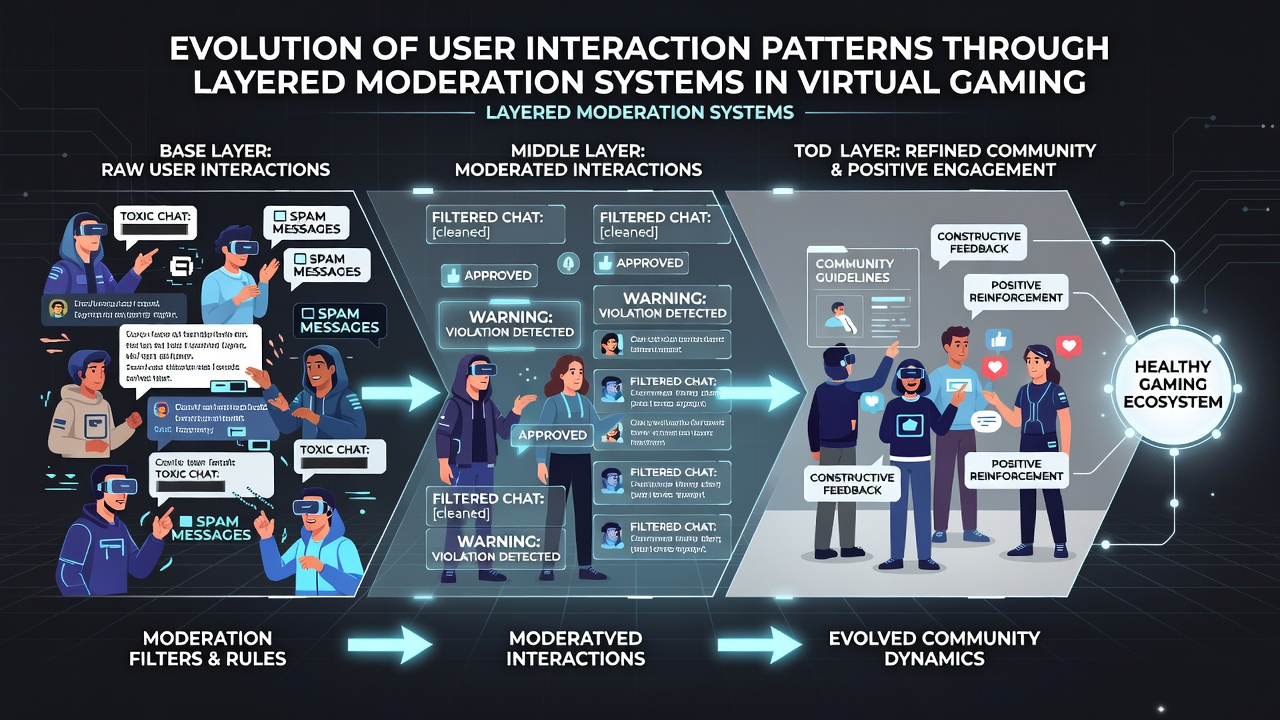
Platforms track these adaptations through aggregated metrics such as message length, emoji usage, and session duration. Evidence suggests that when community tools receive visible results, overall reporting rates stabilize rather than escalate, pointing to a self-regulating equilibrium. External analyses from organizations like the Entertainment Software Association highlight how these dynamics differ across regions, with North American servers showing higher rates of private channel creation than European counterparts during comparable testing windows.
Cross-Platform Data Patterns and Regulatory Context
Comparative studies across multiple virtual environments demonstrate that players who encounter consistent layered enforcement tend to concentrate activity in designated safe zones or role-play servers. Metrics released by research institutions indicate that toxicity scores, measured through standardized sentiment analysis, decline steadily over six-month observation periods when all moderation layers remain active. Yet the same data sets show parallel growth in coded communication that requires periodic system updates to maintain detection accuracy.
Regulatory bodies in Australia and Canada have issued guidelines encouraging transparent reporting on moderation outcomes, which platforms have incorporated into public dashboards. These disclosures allow researchers to correlate policy changes with shifts in user retention and cross-game movement. One notable case involved a large-scale title where updated appeal processes led to measurable increases in returned suspended accounts resuming activity within structured community guidelines.
Conclusion
Layered moderation systems continue to shape interaction patterns through successive stages of detection, review, and community involvement. Platform data and independent studies document clear progression from initial caution toward sustained adaptation, including the development of indirect signaling methods and selective migration. As enforcement mechanisms refine over time, user behavior in virtual gaming environments reflects ongoing calibration between platform rules and collective player strategies.